Learning additional courses apart from your degree courses not only enhances your resume but also opens doors to a wide range of job opportunities. If you are also thinking of doing that, learning programming can be a great option. However, if you ask a professional whether or not you can learn programming in less than a week, then his answer might disappoint you.
But, let’s be honest… Learning programming in less than a week is not practically possible. However, there are some key programming skills that you can learn in a week. This is certainly going to be your first milestone for becoming a developer, and chances are you may get entry to the tech industry. You might also come across platforms where you’re promised to get paid to learn computer programming. However, before you take up those courses, conduct your own research before enrolling.
Coming back to the main question, let’s take a quick look at how to learn programming in less than one week.
Which aspects of programming can you learn in 7 days?
As stated earlier, you cannot master programming skills in just 7 days, but you can certainly learn the basics. Since this skill takes months and years of practice and learning to fully understand, here are the key aspects you can get your hands on in less than a week:
- Get a basic understanding of how programming works.
- Choose one programming language and learn its basic syntax.
- Learn to write simple programs.
- And lastly, build a small beginner-level project.
However, you may not be able to do the following:
- Master the skill of advanced concepts.
- Become ready to take up any job related to programming.
- Get ready to build complex apps.
- And, get ready to understand system design or deep algorithms.
With that in mind, let us take a look at the practical 7-day beginner’s guide to learn programming. Since we have entered 2026, many individuals still look for Best+programming+languages+to+learn+in+2023. However, that should not be the case. Instead, you should look for courses that can help you learn the latest in this field in 2026.
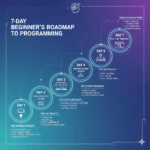
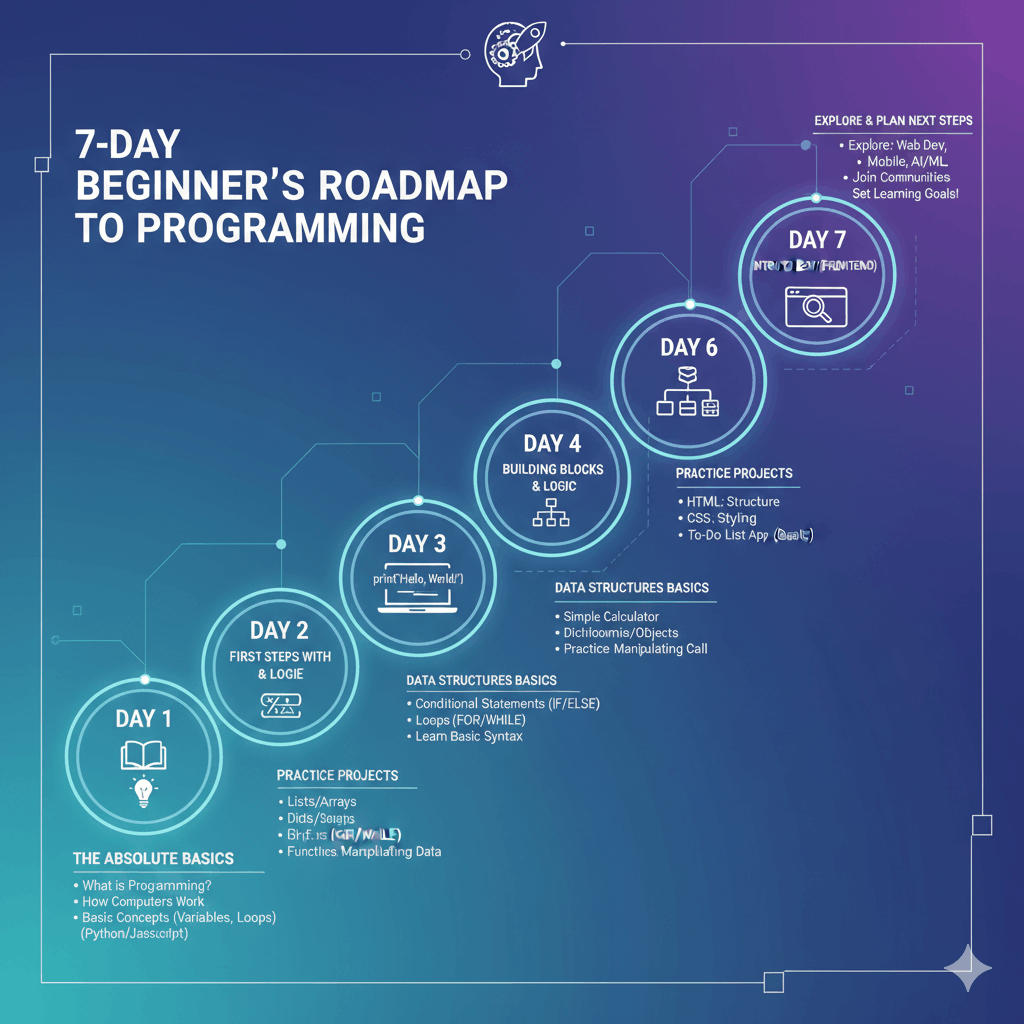
7-day beginner’s Roadmap to Programming

Day 1- Learning the programming fundamentals
To begin with, you should put your focus on learning “what is programming?” and to put it short, we can say that it is not just typing code, it is the use of logical instructions that help in problem-solving. On day 1, you should also learn how devices execute code and the types of programming languages, so that you can choose one to go ahead with, and install a code editor. Lastly, you can also learn how to write your first simple program. The main aim of this day is to get comfortable and familiar with running the code and seeing the output.
Day 2- Get ready to learn data types and variables
Whether you have enrolled for a course where you get paid to learn computer programming or any other course, your focus on day 2 should be to learn variables and data types. Yes, it’s time to move closer to learning about the basic building blocks, such as basic arithmetic operations, variables, data types (Boolean values, strings, and numbers), taking user input and printing out the output. These are the foundation concepts of all programming languages, and hence, you must take time to practice small exercises. You can start by creating a calculator.
Day 3- Learn about Conditional Statements (a.k.a. If-else)
Day 3 calls for creating “decision-making” programs. On this day, you will learn “If statements”, “Else and else-if”, “Logical Operators- AND/OR”, and “Comparison Operators.” With the help of Conditional Logic programs, you can witness programs behaving in a different way based on the provided input. One such example of “Conditional logic” is to calculate grades based on the marks of students. The great news is- this is where programming starts to look interesting and interactive.
Day 4- Repetition and Loops
Most courses on the best+programming+languages+to+learn+in+2023 have this part as the core topic. By learning the use of “Loops,” you will be allowed to create tasks that repeat automatically. On this day, you should put your focus on learning more about “For Loops,” “While Loops”, and “Break and Continue statements.” Besides that, you must learn to print patterns with Loops, process multiple values, and create tables.
Day 5- Code organisation and Functions
This is the time when you are expected to organise your code properly. On this day, your focus should be on understanding the important concepts, such as “What is a Function?”, defining functions, re-usability of code, and parameters and return values. The best thing about “Functions” is that they help you avoid repeating code and make code management easier.
Day 6- Basics of Data Structures
The main aim of using data structures is that they allow you to store and manage multiple pieces of information without using multiple storage systems. To learn everything about data structures, you must get to know more about “Lists of arrays”, “Accessing Elements”, basic operations such as adding and removing items, and looping through collections. The main aim here is handling real-world programming.
Day 7- Try building a simple project
On your final day of learning programming in less than a week, your entire attention should be on building something, maybe small, but complete. Here are a few beginner-level projects you can plan to build:
- A quiz program
- A basic calculator
- Expense tracker
- To-do list app
By building a simple project, you will have a clear picture of what you have learned throughout the week and whether it was a fruitful endeavour.
Conclusion: The Honest Truth
Some institutions where you get paid to learn computer programming may claim that you can learn complete programming in one day. But let me be honest, you cannot. You cannot become a developer in just 7 days of learning. It requires days and months of learning and practice to master the skill of programming. Only by consistency and practice can you become a professional developer and become ready to cash in your skills.